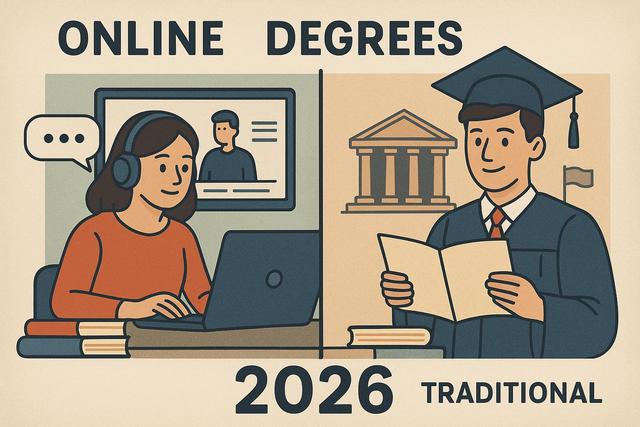
In 2026, the debate around online degrees vs traditional degrees is more relevant than ever. With the increasing digitization of education, choosing the right path involves evaluating factors like cost, quality, networking opportunities, and employer perceptions. This guide provides a comprehensive analysis of both formats to help you make an informed decision.
An online degree is usually completed through digital learning platforms, while a traditional degree is generally delivered on campus through in-person classes. Both formats can lead to a valid academic credential, but the learning experience, schedule, costs, and networking environment can differ significantly.
Cost Efficiency
Tuition and Related Expenses
Online degrees often present a more cost-effective option compared to their traditional counterparts. According to the Education Data Initiative, the average cost of an online degree in 2026 is around $12,000, significantly less than the $37,000 average cost for a four-year traditional degree. This disparity is largely due to reduced overheads associated with running virtual campuses.
Cost is often one of the first factors students compare. Tuition is only one part of the full price of a degree. A clear comparison should also include fees, materials, transport, housing, and the equipment needed to study effectively.
Hidden Costs and Savings
While traditional degrees incur additional costs such as commuting, accommodation, and campus fees, online education can cut these expenses entirely. However, online students should consider technology-related costs like high-speed internet and possibly upgraded computer hardware. Optimizing for cost-efficiency requires evaluating total expenses over the degree duration.
For online students, technology costs are part of the learning setup. A stable internet connection, a reliable computer, and access to required software can affect the overall budget. For traditional students, commuting distance and accommodation choices can strongly influence total expenses.
| Comparison point | Online degrees | Traditional degrees |
|---|---|---|
| Average cost mentioned for 2026 | Around $12,000 | Around $37,000 for a four-year degree |
| Common additional costs | High-speed internet, computer hardware, software access | Commuting, accommodation, campus fees |
| Study location | Remote or flexible location | Campus-based learning environment |
| Schedule structure | Often more flexible, especially with asynchronous courses | More structured and tied to class timetables |
Learning Outcomes
Quality of Education
The prevailing notion that online degrees compromise on quality has been challenged of late. A 2025 study by the Online Learning Consortium showed online education to produce equivalent learning outcomes as traditional classroom settings, particularly in accounting and computer science fields. This shift is driven by the evolution of digital learning platforms and teaching methodologies.
Learning outcomes refer to what students are expected to know or be able to do after completing a course or program. In both online and traditional education, outcomes depend on course design, teaching quality, student support, assessment methods, and the seriousness of the institution.
Assessment and Accreditation
While quality varies among institutions, accreditation plays a pivotal role in ensuring credible education standards. Prospective students should prioritize colleges with recognized accreditation, which assures prospective employers of the degree's legitimacy.
Accreditation means that an institution or program has been reviewed against recognized education standards. For students comparing online college options with campus-based programs, accreditation is a key checkpoint. It helps confirm that the degree is issued by a legitimate provider and that the program follows defined academic requirements.
- Check whether the institution is accredited.
- Review how exams, projects, or assignments are assessed.
- Compare course content with your academic and professional objectives.
- Confirm whether the program provides academic support and feedback.
Networking Opportunities
Building a Professional Network
Networking remains a point of contention for online degrees. Traditional institutions offer immediate access to a community, fostering relationships through in-person interactions. However, online programs counter this with virtual networking events and forums. Industry-specific platforms like LinkedIn Learning are also enhancing networking capabilities among online students.
Networking means building professional and academic relationships. In a traditional setting, this often happens through classroom discussions, campus activities, and informal meetings. In an online setting, networking may happen through discussion boards, video sessions, group projects, virtual events, and professional learning platforms.
Alumni Engagement
Engagement with alumni networks provides additional career support. While traditional universities often have established alumni associations, many online institutions are developing robust alumni networks, exemplifying how digital connectivity bridges geographical barriers.
Alumni engagement can help students stay connected with graduates from the same institution. These networks may support mentoring, professional introductions, and information sharing. The format differs by institution, so students should review how each program supports interaction before enrolling.
Employer Perception
Recognition of Online Credentials
Employer perception is crucial when assessing the value of a degree. A survey by the Society for Human Resource Management in 2025 found that over 60% of hiring managers view online degrees on par with traditional degrees, especially from reputable institutions like Arizona State University Online. This trend indicates a growing acceptance of online education by employers worldwide.
The value of degree credentials can depend on several practical elements. These include the reputation of the institution, accreditation status, relevance of the program, and the skills demonstrated by the graduate. For online degrees vs traditional degrees, the delivery format is only one part of the broader evaluation.
Industry-Specific Preferences
Certain industries, such as technology and digital marketing, have shown a preference for the adaptable and self-motivated nature of online graduates. However, fields such as healthcare still prioritize traditionally-acquired practical experience.
Industry expectations can vary. Some fields may focus strongly on digital skills and independent learning. Others may require structured practical experience, direct supervision, or hands-on training. Students should therefore compare the degree format with the expectations of the field they plan to enter.
Technological Integration
E-Learning Tools
The integration of technology in education is more pronounced in online learning. Platforms such as Coursera and edX Coursera offer MIT or Stanford courses, utilizing AI-driven personalization to enhance learning experiences, equipping students with valuable digital skills.
E-learning tools are digital systems used to deliver lessons, manage assignments, host discussions, or personalize study activities. In online education, these tools are central to the learning process. In traditional education, they may also support classroom teaching, homework, and communication between students and instructors.
Virtual Reality and AI
Advancements in Virtual Reality (VR) are transforming fields like architecture and engineering, where realistic simulations enhance learning. As AI tools continue to evolve, both online and traditional formats are likely to integrate these technologies more deeply into curricula.
Virtual Reality, often shortened to VR, creates simulated environments that can help students practice or visualize complex concepts. AI, or artificial intelligence, can support personalization, feedback, and learning assistance. These technologies may appear in both online and campus-based programs, depending on the curriculum and available tools.
Flexibility and Accessibility
Scheduling and Self-Pacing
The flexibility of online degrees is a significant advantage, particularly for working professionals. With asynchronous courses, students can manage their schedules, allowing them to balance work and study effectively. Traditional degrees, though structured, afford fewer opportunities for customization and pace.
Asynchronous courses are courses that do not require all students to attend at the same time. This format can help learners study around work, family, or other responsibilities. By contrast, traditional degrees usually follow fixed class schedules, which can provide structure but less flexibility.
Accessibility for Diverse Learners
Online education opens doors for learners across geographical and socio-economic boundaries. Programs designed with accessibility features, such as closed captions and screen-reading tools, ensure inclusivity, further expanding online education's reach.
Accessibility features help more learners participate in education. Closed captions support students who need or prefer text with video content. Screen-reading tools help users access written content through audio or other assistive formats. These features can make digital education easier to use for diverse learners.
Conclusion: Making the Right Choice in 2026
When choosing between online and traditional degrees, consider factors like cost, learning outcomes, and employer perception. While online education offers affordability and flexibility, traditional degrees excel in networking and practical knowledge.
A balanced decision starts with your learning needs, available time, financial situation, and the expectations of your field. Online degrees vs traditional degrees should not be compared only by format. They should also be compared by accreditation, course quality, support services, and relevance to your goals.
Implementation Steps
- Evaluate the total cost of attendance for both online and traditional paths.
- Research accreditation status and employer recognition.
- Consider technological advancements integrated into the curriculum.
- Analyze networking opportunities and industry-specific needs.
- Choose the format that best aligns with personal and career objectives.
In 2026, both formats provide valid pathways depending on individual circumstances and career goals. The decision hinges on weighing personal priorities against educational outcomes.
FAQ: Online Degrees vs Traditional Degrees
Are online degrees cheaper than traditional degrees?
Online degrees often cost less than traditional degrees. The article cites an average online degree cost of around $12,000 in 2026, compared with about $37,000 for a four-year traditional degree. Students should still include technology costs when calculating the full price.
Do online degrees have the same learning outcomes?
According to the 2025 Online Learning Consortium study mentioned above, online education produced equivalent learning outcomes to traditional classroom settings in fields such as accounting and computer science. Quality can still vary by institution and program.
Why is accreditation important for an online degree?
Accreditation helps confirm that a college or program meets recognized education standards. It is important for both online and traditional degrees because it supports the credibility and legitimacy of the credential.
Which format offers better networking?
Traditional institutions often provide direct in-person networking through campus life. Online programs may offer virtual networking events, forums, and alumni networks. The better option depends on how each institution organizes student and alumni engagement.
How should students choose between online and traditional degrees?
Students should compare total cost, accreditation, learning outcomes, technology use, networking opportunities, accessibility, and employer perception. The right choice depends on personal circumstances, study preferences, and career objectives.

